
DevelopersEcological Process
Ecological Process
We make ecology simple, predictable and proportionate, helping you move from feasibility to consent with confidence.
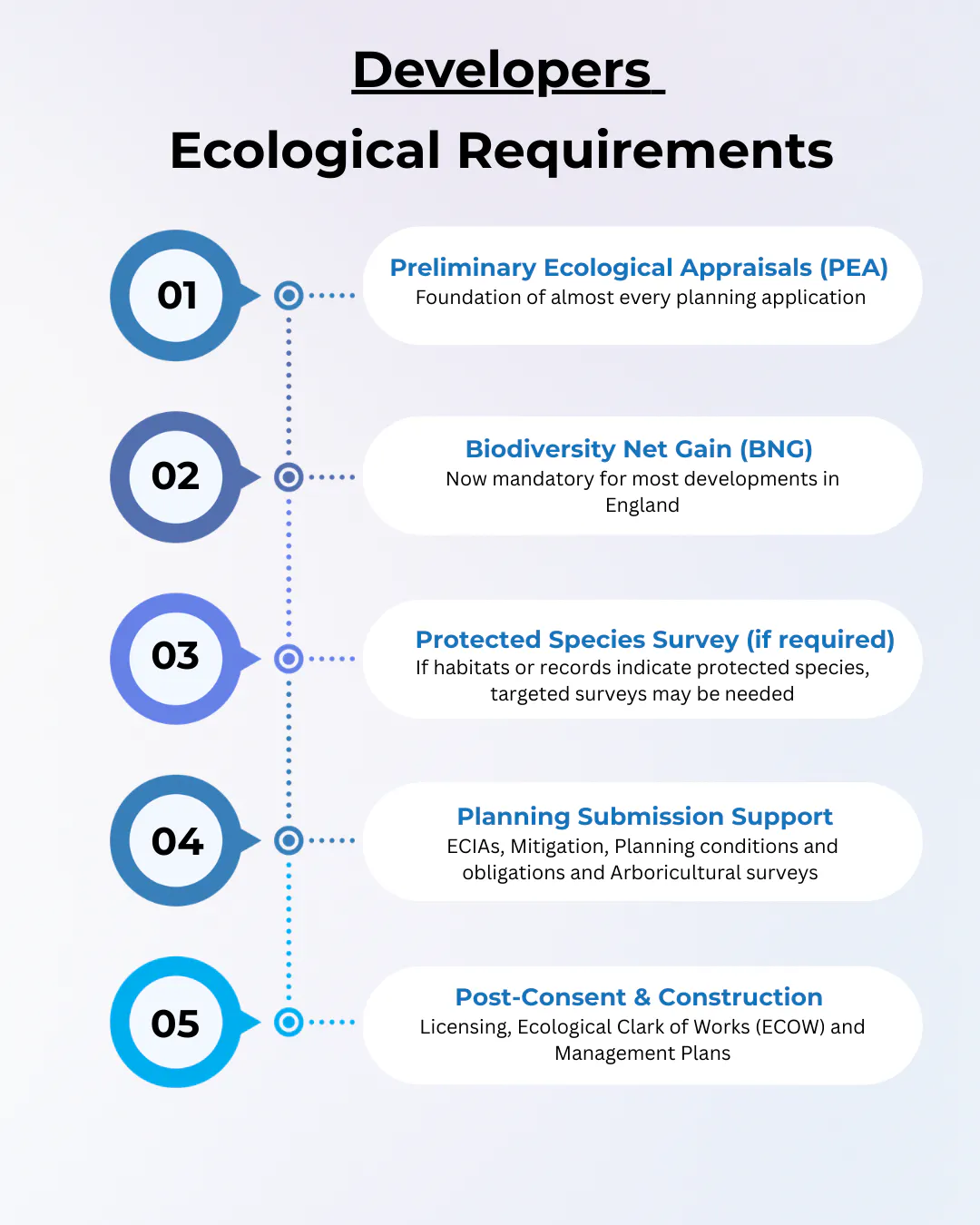
Here’s how ecology typically fits into your development process:
Stage 1: Preliminary Ecological Appraisal (PEA)
The foundation of almost every planning application.
Our PEAs:
- Assess habitats and ecological features
- Identify planning constraints and opportunities
- Set out exactly what further surveys (if any) are needed
- Are written for planners and developers
✔ Often the minimum requirement for a valid planning submission.
These site visits are usually combining with the BNG Survey (Stage 2) if in survey season for flora (April - September).
Stage 2: Biodiversity Net Gain (BNG)
Now mandatory for most developments in England.
We deliver:
- Habitat baseline surveys
- Biodiversity Metric calculations and report, ready for planning applications
- On-site and off-site solutions
👉 More information on BNG surveys can be found here
Stage 3: Protected Species Surveys (if required)
If habitats or records indicate protected species, targeted surveys may be needed, such as for:
Bats, Great Crested Newts, Dormouse, Badger, Reptiles, Breeding birds, etc.
👉 More information on the protected species survey we offer can be found here
We programme surveys around seasonal windows to keep your project moving.
Stage 4: Planning Submission Support
We prepare planning-ready reports including:
- Ecological Impact Assessments (EcIA) where required
- Mitigation strategies
- Planning conditions and obligations
- Arboricultural Surveys (if required)
All aligned with local and national planning policy.
Stage 5: Post-Consent & Construction
We continue supporting you through:
- Protected species licensing (EPS)
- Discharge of planning conditions (Ecological Clark of Works - ECoW)
- Construction / Landscape Ecological Management Plans (CEMP / LEMP)


Contact
The earlier you involve an ecologist, the more control you retain over cost, programme and design.
📞 01622 357 821
📧 hello@adonisblue.org.uk
Or contact Michael Griffin for BNG advice:
📞 07923 253722
📧 michael.griffin@adonisblue.org.uk